What Dolby Atmos does in a soundbar
Traditional surround sound places effects around you at ear level: left, right, front and rear. Dolby Atmos adds a third dimension, height, so a sound can be positioned above you as well. In practice that means rain, aircraft, helicopters or simply the ambience of a large space can seem to come from overhead, making films and games feel more enveloping and three-dimensional. It is the same technology used in cinemas, scaled down for the home.
In a soundbar, that height is created in one of two ways. Either the bar has dedicated up-firing drivers that point at the ceiling and bounce sound down to you, or it uses clever processing to simulate the effect with its forward-facing speakers. Both are sold as Dolby Atmos, but they are not the same experience, and understanding the difference is the key to spending your money well.
Real (up-firing) vs virtual Atmos
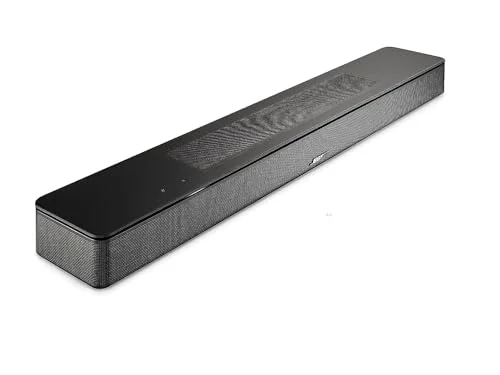
Real Atmos uses up-firing drivers, as on the Samsung HW-Q800C and the compact Bose Smart Soundbar 600. These drivers physically reflect sound off your ceiling, so the height effect is genuine — you can point to where a sound is coming from above. It is the more convincing experience by a clear margin, and it is the reason to choose a bar with up-firing drivers if immersion matters to you.
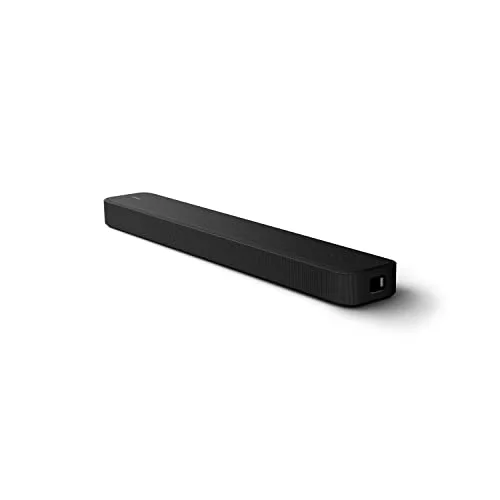
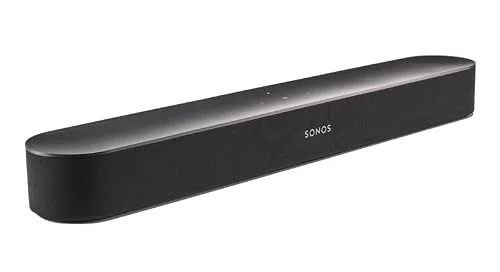
Virtual Atmos, as on the Sonos Beam and the Sony HT-S2000, simulates height using processing alone, with no up-firing drivers. It widens and opens up the sound and gives a pleasant sense of space, but it cannot place a sound clearly overhead the way real Atmos can. Virtual Atmos is not a con — it genuinely improves the sound — but you should know that a bar labelled Atmos at a low price is almost certainly using the virtual approach. If you want the real overhead effect, look specifically for up-firing drivers in the specifications.
Does your ceiling suit a Dolby Atmos soundbar?
This is the question most buyers forget to ask, and it matters a lot for up-firing Atmos. Because the drivers bounce sound off the ceiling, you need a flat, reflective ceiling at a normal height, roughly 2.4 to 3 metres, for the effect to work properly. A flat painted ceiling at that height is ideal. Sloped or vaulted ceilings scatter the reflection and weaken the effect, very high ceilings let too much of the sound dissipate, and soft, absorbent ceilings soak it up. If your ceiling is not suitable, an expensive up-firing bar will not deliver its main advantage, and you would do better with a bar that has excellent stereo sound or virtual Atmos. It is worth checking your ceiling before you pay extra for up-firing drivers.
When a Dolby Atmos soundbar is worth it
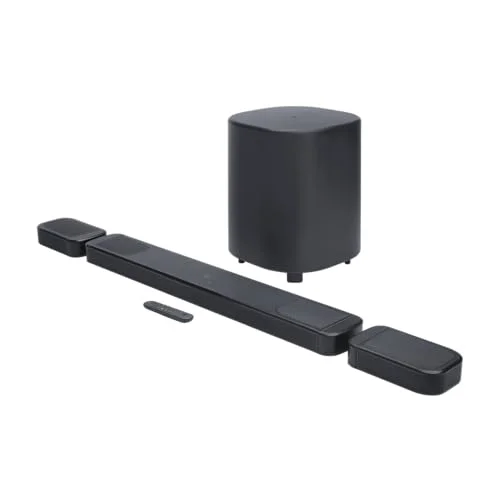
Atmos is worth paying for if you watch a lot of films, you have a suitable flat ceiling, and you value immersion over simplicity. In that case, a real up-firing bar like the Samsung HW-Q800C for a larger room, or the compact Bose Smart Soundbar 600 for a smaller one, transforms film nights. For the most complete effect, the JBL Bar 1000 combines up-firing height with true wireless rear speakers for a full 7.1.4 system.
Atmos is less important if you mostly watch TV, news, sport and drama, where there is little overhead content to enjoy, or if your ceiling is unsuitable. In those cases, a clear, well-balanced bar without up-firing drivers, such as the Sonos Beam, is a better use of your money. Do not let Atmos talk you out of the basics: dialogue clarity and the right size for your room matter more for everyday viewing than height effects you may rarely hear.