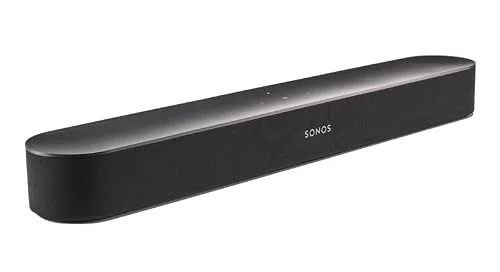
Who is the Sonos Beam (Gen 2) for?
The Beam is the right bar if you want a clear, refined sound from a tidy unit that sets up in minutes, and if you value music as much as TV. It suits small to medium living rooms, bedrooms and flats especially well, because its compact body never dominates a TV unit. For renters and anyone who moves often it is ideal: a single power lead and one HDMI cable, and you are done. It is also the obvious choice if you already own, or might one day buy, other Sonos speakers, because the Beam slots straight into the same app and multiroom system.
It is less suited to a large, open-plan room or to a buyer who wants the most physical, room-shaking film sound out of the box. There is no separate subwoofer included and no up-firing driver, so for a big space or for serious film nights you would be better served by the Samsung HW-Q800C or the JBL Bar 1000. For a normal room, though, the Beam has all the clarity and warmth most people need.
How the Sonos Beam (Gen 2) performs
Dialogue and sound quality
This is where the Beam shines. Speech is exceptionally clear and easy to follow, lifted cleanly above music and effects, and there is a dedicated speech-enhancement mode for late-night viewing or hard-to-hear films. Across TV, films and music the sound is balanced and natural rather than artificially boosted, and it stays composed at volume. For a compact bar it produces a surprisingly full, room-filling sound, and it is genuinely enjoyable to listen to music on, which cannot be said of every soundbar.
Dolby Atmos
The Beam supports Dolby Atmos, but it creates the effect virtually rather than with physical up-firing drivers, because the slim body has none. The result is a convincing sense of width and openness, but it cannot place sound clearly overhead the way a bar with up-firing drivers can. If real height effects are your priority, the Bose Smart Soundbar 600 manages genuine up-firing Atmos in a similarly compact size. For most viewers, the Beam's wider, more spacious sound is more than enough.
Setup and the Sonos app
Setup is the easiest here. You connect the bar to your TV over HDMI eARC, open the Sonos app, and the Trueplay tuning feature measures your room and adjusts the sound to suit it. The app is mature and reliable, gives you easy access to streaming services, AirPlay 2 and voice assistants, and lets you add more Sonos speakers later. It is the most polished, fuss-free experience in the group by a clear margin.
Build and design
The Beam feels like a premium product. The casing is solid, the grille is neat, and the understated design looks at home under any TV without drawing attention to itself. It is small enough to sit in front of a TV without blocking the screen on most stands, and the minimal control surface keeps things clean. This is a bar built to last and to look good for years, not just to tick a spec sheet.
The honest downside: no sub and virtual Atmos
The Beam's only real limitations are the flip side of its compact design. There is no separate subwoofer in the box, so while the bass is good for the size, it cannot match the deep, physical low end of a bar with a dedicated wireless sub. And because there are no up-firing drivers, the Dolby Atmos effect is simulated rather than truly overhead. Neither is a flaw so much as a deliberate trade-off for a small, tidy bar, and both can be addressed later by adding a wireless Sonos Sub or Sub Mini. If you want the deepest bass and real height out of the box, look at a larger system; if you want clarity and refinement in a compact unit, the Beam is hard to beat.